I used to read all the time. Properly, voraciously, in the slightly antisocial way where someone can be talking to you and you are technically listening, but a significant part of your brain is still somewhere else wondering what is happening to the characters you reluctantly left behind when you closed the book.
Then, somewhere in the middle of work, family, phones, television, endless things that needed doing and all the other clutter that seems to accumulate around adult life, I stopped.
Not completely, obviously. I still read things, and there would be bursts when I disappeared into a book on holiday, but reading stopped being part of my normal life in the way it had been when I was younger. I am not entirely sure when it happened, which is probably the point. Nobody wakes up one morning and announces that they are giving up something they have loved for decades because they would rather spend their evenings looking at their phone. It just gets squeezed out.
Over the last year or so I have deliberately brought it back, partly because I love books and partly because I realised I needed something that actually made me stop.
There is an important distinction here because scrolling does not do that for me. I can spend half an hour on my phone and emerge knowing slightly more about somebody I have never met, three things currently wrong with the world and, inexplicably, how somebody in Ohio has reorganised their pantry, while feeling no more rested than I did when I started.
A book occupies my brain differently. I cannot simultaneously read a novel, answer an email, check the weather and remember that I need to order dishwasher tablets. Well, I probably can, but none of those things will be done particularly well. Reading demands just enough concentration to shut some of the other noise out, which is precisely why I think I had forgotten how much I needed it.
There is, admittedly, a flaw in this otherwise excellent relaxation strategy. I am terrible at putting a good book down.
Give me something I really love and all sensible intentions about getting an early night disappear remarkably quickly. I will read one more chapter, followed by another one because the previous chapter ended somewhere completely unreasonable, and suddenly it is well past midnight and I am doing calculations about how much sleep I can technically survive on.
This occasionally means that my wholesome attempt to rest leaves me physically exhausted for the next two days, although mentally I feel considerably better, which possibly sums up my approach to wellbeing more accurately than anything else I have written on this blog.
Apparently I like escaping
Looking at the books I have enjoyed most this year, there is definitely a theme, although I am not sure it is particularly sophisticated. I like escaping somewhere else.
I love fantasy and romantasy, and have done since I discovered Tad Williams’ Memory, Sorrow and Thorn as a teenager and realised that disappearing into an enormous invented world for hundreds of pages was a perfectly legitimate use of my time. I like magic, complicated relationships, worlds with their own histories and rules, and preferably enough books in a series that I do not have to leave again too quickly.
I also seem to be drawn towards strong women at the centre of stories, although not necessarily the polished, fearless sort who stride around knowing exactly what they are doing. Give me complicated women, women who make mistakes, women who are underestimated, women finding their way through circumstances they did not choose, and I am probably interested.
That might explain why one of my favourites this year sits some distance from my fantasy comfort zone.
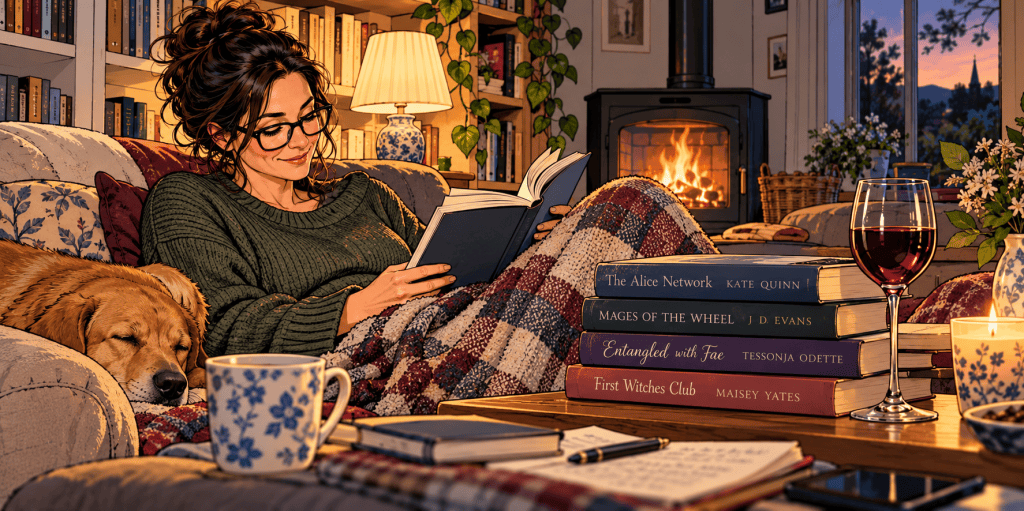
The Alice Network by Kate Quinn
The Alice Network was one of those books that reminded me how much I enjoy historical fiction when it takes real history and gives it flesh.
It moves between two periods and draws on the real Alice Network, the female spy network operating during the First World War, although the novel itself blends that history with fictional characters and stories. What caught me was not simply the espionage or the history, but the women at its centre and the realities of what courage can look like when it is considerably less glamorous than hindsight sometimes makes it.
I am fascinated by stories of women whose contribution was extraordinary but who did not occupy the traditional version of power, particularly when there is some real history underneath the fiction. Perhaps there is an element of wanting to know about the people who were there all along but did not always make it into the version of history we were taught at school.
For anyone that enjoys this kind of book, I would highly recommend A Woman of No Importance by Sonia Purnell that tells the true story of Virginia Hall.
Mages of the Wheel by J. D. Evans
Then we return firmly to my natural habitat.
The Mages of the Wheel series has magic, politics, relationships and a world large enough to disappear into, which ticks rather a lot of boxes for me. It is exactly the sort of fantasy that reminds me why I fell in love with the genre in the first place.
There is something wonderfully absorbing about a properly constructed fantasy world because your brain has to leave this one for a while. You cannot spend all your time thinking about tomorrow’s list when you are busy keeping track of magical systems, political manoeuvring and people making questionable romantic decisions.
Perhaps escapism occasionally gets treated as though it is somehow inferior to reading something terribly improving, but I have never really understood that. I read because I enjoy it. Sometimes I want a book to teach me something or make me look differently at the world, and sometimes I want it to take the world away altogether for a few hours.
I enjoyed this one as it did not have the traditional Western setting for the main part.
Entangled with Fae by Tessonja Odette
Entangled with Fae sits very happily in the part of my reading brain that wants fairy tales, fantasy and romance without requiring me to pretend that I have picked it up for its educational value.
There was probably a time when I would have felt the need to balance this list with something more serious, as though enjoying romantasy needed to be offset by a sufficiently intellectual book sitting prominently on the coffee table. I am getting much better at not caring.
There is something particularly comforting about familiar ingredients used well. Magic, romance, fairy tale elements and a world sufficiently removed from everyday life that, for a while, nobody is asking whether you remembered to put the bins out. The fairy tales these were based on were instantly recognisable without the story ever feeling stale.
First Witches Club by Maisey Yates
And apparently there is room for more witches.
First Witches Club was another of my favourite escapes this year, combining magic with women and relationships in a way that clearly knows its audience, of which I am very obviously one.
What I increasingly notice about the books I enjoy is that I do not necessarily need their female characters to be extraordinary. I want them to be interesting. I want friendships, flaws, humour, bad decisions, resilience and women with enough agency to drive their own stories rather than simply appearing in somebody else’s.
Perhaps that is one reason these books have accompanied me so well this year. Escapism does not necessarily mean wanting stories completely disconnected from our own lives. Sometimes the setting can be fantastical while the people within it feel surprisingly familiar.
Reading badly may still be good for me
I have no intention of turning reading into another wellbeing prescription because that rather ruins the point.
I do not have a target for the number of books I should read each month. I am not particularly interested in whether I am reading the right books, and I refuse to believe that a worthy book I am forcing myself through is inherently better for me than a ridiculous fantasy novel I cannot put down.
What bringing books back into my life has done is give me permission to disappear for a while.
It makes me sit down. It occupies the part of my brain that otherwise has an irritating tendency to wander back towards work or whatever else I think I ought to be doing. It has reminded me that doing something purely because I enjoy it is actually a perfectly good reason to do it.
There are still evenings when I scroll instead. There is one book I abandoned because life is too short, there were other things I wanted to read and it simply was not compelling enough. I may well pick it back up when I am sat sipping wine on a foreign balcony somewhere.
There are also nights when I completely undermine the restorative benefits of reading by looking at the clock, discovering it is 1.17am and deciding that another chapter seems entirely reasonable.
I can live with that because I think what I had lost when I stopped reading regularly was not simply books. I had lost one of the easiest ways I know of stepping outside my own head for a while, and in a life where there is almost always something else demanding attention, being somewhere completely different for a few hundred pages turns out to be rather useful.

Leave a Reply