Yes. The idea is right, but the rhythm slipped back towards punchy social writing, particularly in the second half. For Halfcut I would let the thoughts wander a little more, with the humour sitting inside the sentences rather than relying on short lines for emphasis. How M&S Sucked Me Back In I appear to have fallen back in love with Marks and Spencer, which is not something I particularly expected to happen and, if you had asked me six months ago what might rekindle the relationship, I am fairly certain cleaning spray would not have featured prominently in my answer. For years M&S had occupied a very specific place in my life because, like any sensible woman, I bought knickers there, particularly if I happened to be passing an outlet where I could stock up while feeling smug about the discount. I also had a Sparks card, although it spent considerably more time living in my digital wallet than actually doing anything useful, and beyond the occasional wander through the food hall I had rather stopped thinking of M&S as somewhere I routinely shopped. Then Instagram sold me Purdy and Figg. I had seen the adverts often enough that eventually curiosity won, so I ordered one of their bottles and a selection of scents and, to be fair to them, I loved the fragrances and rather liked the whole idea of making cleaning smell considerably less like cleaning. It even prompted an unexpected outbreak of enthusiasm for tackling radiators and some of the other hidden surfaces that years of weekend working, family life and a growing aversion to being the only person in the household apparently capable of seeing certain forms of mess had allowed me to quietly ignore. Unfortunately, after a while I started having problems with the bottles not spraying properly, which rather undermined the pleasure of reaching purposefully for my lovely plant based cleaning spray only to spend the next few minutes squeezing the trigger with increasing irritation while absolutely nothing came out. So I started looking for an alternative, with requirements that seemed fairly modest. I liked the idea of something plant based, I definitely wanted it to smell good, and above all I wanted something that would bloody work when I picked it up. Which is how I found myself back in M&S. I went in specifically for the cleaning range, found what I wanted and, because we had friends coming over for lunch, wandered into the food hall and picked up some cheese for the cheeseboard while I was there. At the till I dutifully produced my largely neglected Sparks card, went home with my cleaning products and cheese, and thought very little more about any of it. Except M&S apparently had other ideas. The offers started arriving by email, most of which I treated in exactly the same way as the enormous quantity of marketing that lands in my inbox every week, which is to delete it without reading it until eventually becoming sufficiently irritated to unsubscribe. Then they caught me with an advert for the beauty advent calendar at almost precisely the moment I had been wondering whether I really wanted another chocolate one this year. I normally avoid beauty advent calendars because they can be an extremely expensive way of acquiring an impressive collection of tiny products you would never actually have bought, several of which will inevitably still be sitting untouched at the back of a bathroom cupboard three years later, but I made the mistake of looking at what was inside this one and realised that there was a surprisingly large proportion of it that I genuinely wanted to try. Even then I did not buy it immediately because one of my better defences against impulse shopping is simply to get distracted, which happens often enough that it is probably the most reliable financial strategy I have. I wandered off, thought about other things and came back to it about 24 hours later, by which point I still wanted it and could therefore start constructing a perfectly reasonable argument for buying it. I downloaded the app because the calendar was available to Sparks members for seven days before general release, connected my card and discovered that I also had an offer giving me money back if I spent a certain amount on beauty, at which point the remaining resistance disappeared and I ordered it. So far, so predictable, but while I was in the app I started scrolling through the recipes and found one involving chicken and polenta that looked rather good. The recipe used a tomato, herb and garlic paste I had not tried before, so I added the meal to the meal plan, put the ingredients onto the shopping list and promptly forgot all about it until its turn eventually came around on the rota. There is a small flaw in this story, which is that when I actually made the meal I had not bought the M&S paste at all and ended up with a Tesco version instead. It was perfectly nice, the dinner was very good and nobody sitting around the table felt that their evening had been diminished by the provenance of the tomato paste, although I do now have the M&S version in the cupboard and clearly a highly scientific comparison will eventually be required. Somewhere along the way there have also been a couple of new tea towels, several recipes that have gone into regular consideration, some genuinely good food and a useful amount of money back through Sparks, yet none of it has felt particularly extravagant, which is the bit I find interesting. Has the idea of a treat changed? We are living through a period when almost everybody is more conscious of what things cost, and I wonder whether one of the quieter effects of the cost of living crisis is that the gap between what we think of as an everyday purchase and a small luxury has shifted. When an entirely ordinary supermarket shop can cost enough to make you examine the receipt in mild disbelief, spending a little more on one particular thing that you really enjoy can feel less extravagant than it once did, particularly if you are saving elsewhere. Perhaps there is also an element of wanting the occasional purchase to actually feel like a treat when so much of our money disappears on things that are necessary but spectacularly unexciting. That certainly does not mean I am about to start doing the entire weekly shop in M&S because I have both a mortgage and some remaining grip on reality, and if Tesco, Aldi or anywhere else sells something I like for less money I am perfectly happy to buy it there. I remain unconvinced that chopped tomatoes experience any meaningful spiritual improvement because they have come from a more expensive supermarket. There are other things, though, where spending slightly more genuinely gives me something back, whether that is a cleaning product that smells lovely enough to make tackling the kitchen marginally more appealing, cheese that I particularly enjoy when friends are coming over, or apparently a new tea towel that makes me disproportionately pleased every time I see it hanging from the oven door. I think I am getting better at knowing the difference. Being sensible does not have to mean removing all the fun There can be something rather joyless about the way we sometimes talk about saving money, particularly during a cost of living crisis, because the advice can drift towards the idea that financial responsibility means stripping away every unnecessary pleasure until you are left buying only the cheapest possible version of everything and feeling guilty whenever you do anything else. There are, of course, plenty of households where there genuinely is no room in the budget for treats at the moment, and no amount of clever shopping, loyalty points or cashback changes that reality, so I do not want to pretend that everybody can simply shop their way to a more cheerful version of financial restraint. For those of us who do have some choice, however, I think there is a useful middle ground between spending without thinking and making economy into a form of self punishment, and increasingly that is where I am happiest. I will happily buy the cheaper version when it is just as good, wait for an offer when there is one, use cashback rather than ignoring it and decide that some things simply are not worth paying extra for, but I am also increasingly comfortable spending a little more when I know I will genuinely enjoy the difference. The important bit, for me at least, is that buying the premium version of one thing does not somehow mean I need the premium version of everything. Perhaps that is the real trick behind why M&S has managed to suck me back in, because it has somehow inserted itself into that middle ground where something can feel a little bit nicer without necessarily feeling wildly extravagant. A cleaning product got me through the door, cheese persuaded me to use the Sparks card, an advent calendar got me onto the app, the app led me to recipes and the recipes brought me back to the food, while somewhere in the middle of all that I apparently reached the stage of life where buying new tea towels counts as treating myself. I can see the marketing machinery at work here and admire how effectively I have walked straight into it, but I am surprisingly untroubled by that because the things I have bought have been things I wanted, used and enjoyed, rather than the beginnings of some grand attempt to upgrade every ordinary object in my life. Perhaps affordable luxury, if that is not too grand a description for cleaning spray and tea towels, is simply about becoming more deliberate about where the extra money actually buys you some extra pleasure. Sometimes the supermarket version is perfectly good, sometimes the thing on offer is worth waiting for, and sometimes you decide that yes, you really would rather have the nicer one. Twenty year old me might be deeply concerned that this is where life has brought us, but she did not have to clean the radiators.

How M&S Sucked Me Back In

I appear to have fallen back in love with Marks and Spencer, which is not something I particularly expected to happen and, if you had asked me six months ago what might rekindle the relationship, I am fairly certain cleaning spray would not have featured prominently in my answer.

For years M&S had occupied a very specific place in my life because, like any sensible woman, I bought knickers there, particularly if I happened to be passing an outlet where I could stock up while feeling smug about the discount. I also had a Sparks card, although it spent considerably more time living in my digital wallet than actually doing anything useful, and beyond the occasional wander through the food hall I had rather stopped thinking of M&S as somewhere I routinely shopped.

Then Instagram sold me Purdy and Figg.

I had seen the adverts often enough that eventually curiosity won, so I ordered one of their bottles and a selection of scents and, to be fair to them, I loved the fragrances and rather liked the whole idea of making cleaning smell considerably less like cleaning. It even prompted an unexpected outbreak of enthusiasm for tackling radiators and some of the other hidden surfaces that years of weekend working, family life and a growing aversion to being the only person in the household apparently capable of seeing certain forms of mess had allowed me to ignore.

Unfortunately, after a while I started having problems with the bottles not spraying properly, which rather undermined the pleasure of reaching purposefully for my lovely plant based cleaning spray only to spend the next few minutes squeezing the trigger with increasing irritation while absolutely nothing came out or it trickled out and over my head in a way that was really unpleasantly reminiscent of failed romantic encounters.

I started looking for an alternative, to the cleaning product obviously, romantic encounters have been solved by being shacked up with the same man for 20 years. My requirements seemed fairly modest. I liked the idea of something plant based, I definitely wanted it to smell good, and above all I wanted something that would bloody work when I picked it up.

Which is how I found myself back in M&S.

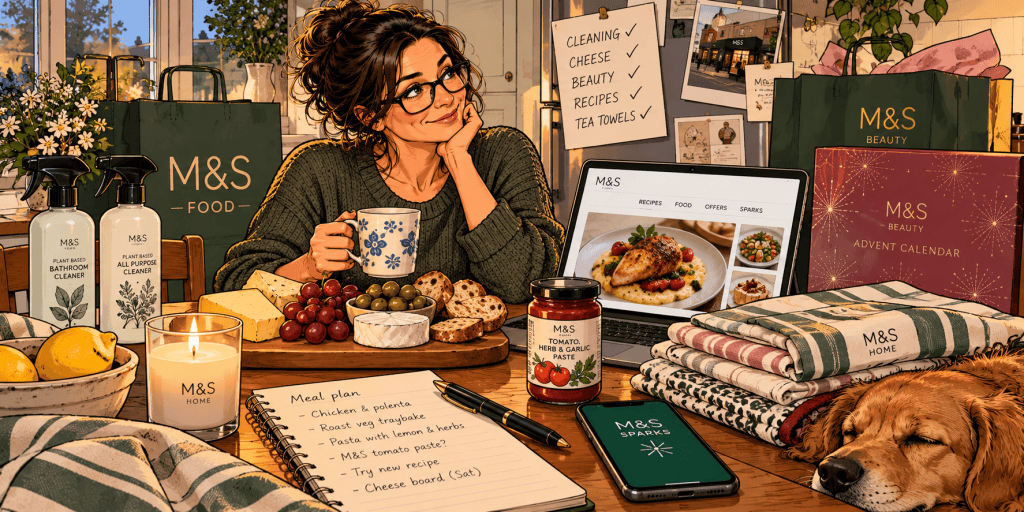
I went in specifically for the cleaning range, found what I wanted and, because we had friends coming over for lunch, picked up some cheese for the cheeseboard while I was there. At the till I dutifully produced my largely neglected Sparks card, went home with my cleaning products and cheese, and thought very little more about any of it.

Except M&S apparently had other ideas.

The offers started arriving by email, most of which I treated in exactly the same way as the enormous quantity of marketing that lands in my inbox every week, which is to delete it without reading it until eventually becoming sufficiently irritated to unsubscribe. Then they caught me with an advert for the beauty advent calendar at almost precisely the moment I had been wondering whether I really wanted another chocolate one this year.

I normally avoid beauty advent calendars because they can be an extremely expensive way of acquiring an impressive collection of tiny products you would never actually have bought, several of which will inevitably still be sitting untouched at the back of a bathroom cupboard three years later, but I made the mistake of looking at what was inside this one and realised that there was a surprisingly large proportion of it that I genuinely wanted to try.

Even then I did not buy it immediately because one of my better defences against impulse shopping is simply to get distracted, which happens often enough that it is probably the most reliable financial strategy I have. I wandered off, thought about other things and came back to it about 24 hours later, by which point I still wanted it and could therefore start constructing a perfectly reasonable argument for buying it.

I visited the app because the calendar was available to Sparks members for seven days before general release and discovered that I also had an offer giving me money back if I spent a certain amount on beauty, at which point the remaining resistance disappeared and I ordered it.

So far, so predictable, but while I was in the app I started scrolling through the recipes and found one involving chicken and polenta that looked rather good. The recipe used a tomato, herb and garlic paste I had not tried before, so I added the meal to the meal plan, put the ingredients onto the shopping list and promptly forgot all about it until its turn eventually came around on the rota.

There is a small flaw in this story, which is that when I actually made the meal I had not bought the M&S paste at all and ended up with a Tesco version instead. It was perfectly nice, the dinner was very good and nobody sitting around the table felt that their evening had been diminished by the provenance of the tomato paste, although I do now have the M&S version in the cupboard and clearly a highly scientific comparison will eventually be required.

Somewhere along the way there have also been a couple of new tea towels, several recipes that have gone into regular consideration, some genuinely good food and a useful amount of money back through Sparks, yet none of it has felt particularly extravagant, which is the bit I find interesting.

Has the idea of a treat changed?

We are living through a period when almost everybody is more conscious of what things cost, and I wonder whether one of the quieter effects of the cost of living crisis is that the gap between what we think of as an everyday purchase and a small luxury has shifted.

When an entirely ordinary supermarket shop can cost enough to make you examine the receipt in mild disbelief, spending a little more on one particular thing that you really enjoy can feel less extravagant than it once did, particularly if you are saving elsewhere. Perhaps there is also an element of wanting the occasional purchase to actually feel like a treat when so much of our money disappears on things that are necessary but spectacularly unexciting.

That certainly does not mean I am about to start doing the entire weekly shop in M&S because I have both a mortgage and some remaining grip on reality, and if Tesco, Aldi or anywhere else sells something I like for less money I am perfectly happy to buy it there. I remain unconvinced that chopped tomatoes experience any meaningful spiritual improvement because they have come from a more expensive supermarket with promises of being hand picked by village maidens.

There are other things, though, where spending slightly more genuinely gives me something back, whether that is a cleaning product that smells lovely enough to make tackling the kitchen marginally more appealing, cheese that I particularly enjoy when friends are coming over, or apparently a new tea towel that makes me disproportionately pleased every time I see it hanging from the oven door.

I think I am getting better at knowing the difference.

Being sensible does not have to mean removing all the fun

There can be something rather joyless about the way we sometimes talk about saving money, particularly during a cost of living crisis, because the advice can drift towards the idea that financial responsibility means stripping away every unnecessary pleasure until you are left buying only the cheapest possible version of everything and feeling guilty whenever you do anything else.

There are, of course, plenty of households where there genuinely is no room in the budget for treats at the moment, and no amount of clever shopping, loyalty points or cashback changes that reality, so I do not want to pretend that everybody can simply shop their way to a more cheerful version of financial restraint.

For those of us who do have some choice, however, I think there is a useful middle ground between spending without thinking and making economy into a form of self punishment, and increasingly that is where I am happiest.

I will happily buy the cheaper version when it is just as good, wait for an offer when there is one, use cashback rather than ignoring it and decide that some things simply are not worth paying extra for, but I am also increasingly comfortable spending a little more when I know I will genuinely enjoy the difference. The important bit, for me at least, is that buying the premium version of one thing does not somehow mean I need the premium version of everything.

Perhaps that is the real trick behind why M&S has managed to suck me back in, because it has somehow inserted itself into that middle ground where something can feel a little bit nicer without necessarily feeling wildly extravagant. A cleaning product got me through the door, cheese persuaded me to use the Sparks card, an advent calendar got me back onto the app, the app led me to recipes and the recipes brought me back to the food, while somewhere in the middle of all that I apparently reached the stage of life where buying new tea towels counts as treating myself.

I can see the marketing machinery at work here and admire how effectively I have walked straight into it, but I am surprisingly untroubled by that because the things I have bought have been things I wanted, used and enjoyed, rather than the beginnings of some grand attempt to upgrade every ordinary object in my life.

Perhaps affordable luxury, if that is not too grand a description for cleaning spray and tea towels, is simply about becoming more deliberate about where the extra money actually buys you some extra pleasure. Sometimes the supermarket version is perfectly good, sometimes the thing on offer is worth waiting for, and sometimes you decide that yes, you really would rather have the nicer one.

Twenty year old me might be deeply concerned that this is where life has brought us, but she did not have to clean the radiators.


Discover more from The Half Cut Blog

Subscribe to get the latest posts sent to your email.


Comments

Leave a Reply